SANSKRIT THEATRE,CLASSICAL ART
 |
| Kutiyattum |
Kutiyattam literally means "acting together". This is the earliest classical dramatic art form of Kerala. Based on Sage Bharatha's 'Natyasasthra' who lived in the second century, Kutiyattam evolved in the 9th century AD.
Kutiyattam is enacted inside the temple theatre, there are two or more characters onstage at the same time, with the Chakkiars providing the male cast and the Nangiars playing the female roles. The Nangiars beat the cymbals and recite verses in Sanskrit, while in the background Nambiars play the Mizhavu, a large copper drum.
Vidushaka or the wise man, a figure parallel to the Fool in Shakespearean plays, enacts his role with the liberty to criticise anyone without fear. The costume of the jester sets him apart from the rest. The Kutiyattam performance lasts for several days ranging from 6 to 20 days. Themes are based on mythology.
The Koodal Manikyam temple at Irinjalakkuda and the Vadakkumnatha temple at Thrissur are the main centres where Kutiyattam is still performed annually. Late Ammannoor Madhava Chakkiar was an unrivalled maestro of this rare art form.
TEMPLE ART,PERFORMING ART
 |
| Krishnanattom |
A spectacle for both the scholar and the simple rustic. The visual effect is enhanced by varied and colourful facial make-up with larger-than-life-masks, made of light wood and cloth padding, for certain characters. The characters who do not wear masks have specific facial colours applied within the frame of a white chutti. The predominant colours used are dark green, flesh tint and deep rose. Most of the characters wear red vests and flowing 'Uthariyams'. The characters of Krishna, Arjuna and Garuda wear dark blue vests.
The traditional performance lasts for eight days and covers the whole span of Krishna's life from his birth to 'Swargarohanam' or ascension to the heavens. Orchestral accompaniments are Maddalam, Ilathalam and Chengila. Krishnanattom, though boasting of a unique choreography, assumes more the nature of a Morality Play, seldom presuming to lay claim to the theatrical sophistry so integral to Kathakali and Kootiyattam.
SOCIO-RELIGIOUS ART
 |
| KOOTHU |
Koothu is a socio-religious art performed in the Koothambalam or the Koothuthara of temples, either independently or as part of Kootiyattam. It is a solo narrative performance interspersed with mime and comic interludes. The Chakkiar dons the role of 'Vidushaka'or the wise jester. Through his inimitable narration of stories from the epics (The Ramayana and The Mahabharatha), the Chakkiar satirises the manners and customs of the time. No one is above the butt of his ridicule. His wit ranges from innocent mockery to veiled innuendoes, barbed pun and pungent invectives. Koothu is intermittently accompanied by the percussion instrument Mizhavu. The Nangyar Koothu is a variation of the Koothu performed by the Nangiars or the female members of the Chakkiar community. This is a solo dance drama mainly centred on the legends of Sree Krishna. Verses are sung and interpreted through mime and dance. The mudras, though the same as in Kootiyattam, are even more elaborate. The art form is still performed in temples like Vadakkumnatha temple at Thrissur, Sri Krishna temple at Ambalappuzha, Koodal Manikyam temple at Irinjalakkuda and Kumaranalloor temple at Kottayam.
FOLK ART,PERFORMING ART
Kolkkali is a highly rhythmic folk art. The dancers wielding short pairs of sticks move in circles around a nilavilakku as they sing and dance tapping each others stick. Though the dancers break away to form different patterns, they never miss a beat. In Malabar, Kolkkali is more popular among Muslim men.
DANCE DRAMA-PERFORMING ARTS

Presented in the temple precincts after dusk falls, Kathakali is heralded by the Kelikottu or the beating of drums and to the accompaniment of the Chengila (gong). The riches of a happy blending of colour, expressions, music, drama and dance are unparallelled in any other art form.
Kathakali Make-up
Costume is elaborate with the face painted up. Great importance is laid on the Vesham or make-up which are of five types - Pacha, Kathi, Thadi, Kari and Minukku.
The pomp and magnificence of Kathakali is partly due to its décor, part of which is the kireetam or huge headgear and the kanchukam the over sized jackets, and a long skirt worn over a thick padding of cushions. The identity of the actor is completely mutilated to create a super human being of larger-than-life proportion.
Pacha (Green)
Pacha Vehsam or the green make-up portray noble protagonists.
Kathi (Knife)
Kathi Vesham portrays villainous characters.
Thadi (Beard)
There are three types of bearded or Thadi Veshams.
"Vella Thadi" or White beard for superhuman monkeys like Hanuman.
"Chuvanna Thadi" or Red beard meant for evil characters.
"Karutha Thadi" or Black beard for the hunter.
Kari (Black)
Kari Vesham is used for she-demons.
Minukku (Prettying Up)
The "Minukku Vesham" is used for female characters and sages.
Mudra
Mudra is a stylized sign language used to depict an idea, a situation or a state of being. A Kathakali actor enacts his ideas through mudras. For this the actor follows a systematic sign language based on Hastalakshana Deepika, a treatise on the language of hand gestures.
Kathakali Music
Kathakali orchestra is formed of two varieties of drums - the maddalam and chenda; the chengila which is a bell metal gong and the ilathalam or cymbals.
Kathakali Training
Students of Kathakali have to undergo rigorous training replete with oil massages and separate exercises for eyes, lips, cheeks, mouth and neck. Abhinaya or expression is of prime importance as is nritya or dance and geetham or singing.
Together with highly evocative facial expressions, the mudras and the music both vocal and instrumental, Kathakali unfolds stories from a bygone era in a lofty style reminiscent of the Greek plays. Kerala Kalamandalam is the prominent institution imparting Kathakali training in the traditional way.
SATIRICAL DANCE-DRAMA OF KERLA
 |
| Kakkarissi |
Kakkarissi Natakom is a satirical dance-drama based on the puranic legends of Lord Siva and his consort Parvati when they assumed human forms as Kakkalan and Kakkathi - a nomadic tribe of fortune tellers. The legend only serves as a skeletal framework for the play, which often turns into a subtle critique of contemporary society. The language is a blend of Tamil and Malayalam. The chief characters are Kakkalan, Kakkathi, Vedan, Velichappadu, Thampuraan and the ubiquitous Jester. The Dholak, Ganchira, Chenda and the Harmonium provide the background score.
PERFORMING ART OF MALABAR
 |
| Daffumuttu\ |
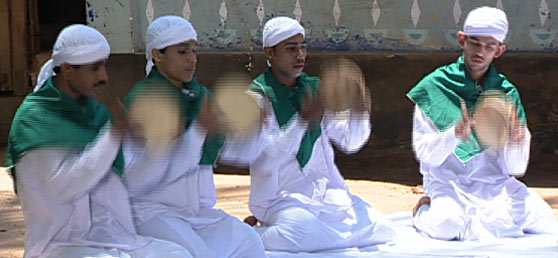
Duffmuttu is also known as Aravanamuttu. It is a group performance popular among the Muslims of Malabar. Duffmuttu is staged as a social event during festivals and nuptial ceremonies.
The artistes beat on a shallow round percussion instrument called the Duffu. The leader of the group sings the lead, while the others form the chorus and move in circles. The songs are often tributes to martyrs, heroes and saints.
Duffmuttu can be performed at any time of the day and has no fixed time limit.